

The JAI attends IPAC 2026 in Deauville, France
The International Particle Accelerator Conference (IPAC) is an annual gathering of the global accelerator community. This year IPAC was held from May 17th - 22nd in Deauville, France. Many members of the JAI had the opportunity to attend and present, using this unique occasion to communicate, form collaborations, and explore the latest breakthroughs in accelerator research and development, whilst also enjoying the what the location had to offer! Some of our members share their experience below.
Sasha Horney
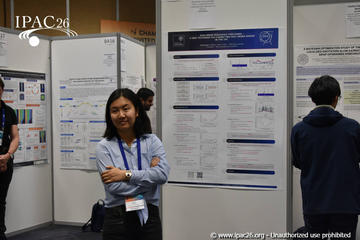
Sasha Horney next to one of her posters at IPAC 2026
I had the privilege of presenting two posters at IPAC 2026: “Correction of Long-Range Beam-Beam Driven Optics Perturbations for the LHC” and “Non-Linear Resonance Feed-Down - A New Technique for Correcting High-Order Errors in the LHC”. The conference provided an excellent opportunity to discuss my research with people from across the accelerator community and receive valuable feedback on work that forms a significant part of my DPhil thesis. Presenting these results helped me consolidate my understanding of the material, refine my ability to communicate the underlying concepts, and gain some useful experience ahead of my upcoming viva. I would like to thank the conference committee for awarding me a student grant, which enabled me to attend and contribute to the event. I am also very grateful to my CERN and Oxford supervisors, as well as my co-authors and collaborators, for their guidance, support, and contributions throughout this work.
Beyond presenting my own research, one of the most rewarding aspects of the conference has been engaging with fellow researchers, engineers, and industry representatives from around the world. I have particularly enjoyed learning about the diverse projects and ideas being pursued across the accelerator community and hearing different perspectives on current challenges and future developments in the field. I was also pleased to take part in the new Hackathonino initiative, which introduced me to quantum walks, an area entirely new to me. In addition, I have been enjoying the (still ongoing) student puzzles organised during the conference, which have provided a fun and engaging challenge while offering another opportunity to connect with fellow attendees outside the technical programme.
Emily Howling
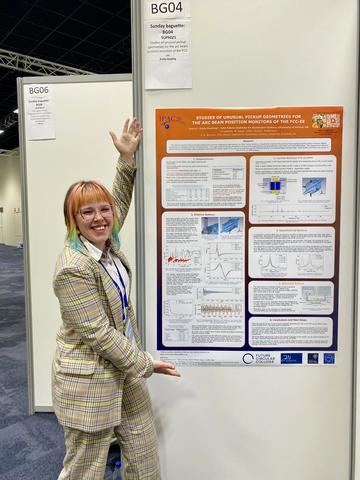
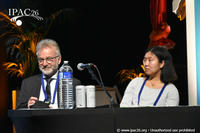
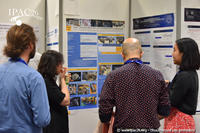
Emily Howling and her IPAC 2026 poster
I had the privilege of attending IPAC 2026 in Deauville, France, as a recipient of the student grant. This was an excellent opportunity to present key aspects of my DPhil research and to engage with colleagues working at many different facilities, who provided a lot of useful insight.
I presented a poster titled, ‘Studies of Unusual Pickup Geometries for the Arc Beam Position Monitors of the FCC-ee.’ There was a many an interesting discussion around the poster, from working out practical aspects of installing certain pickup geometries, to the nitty gritty of CST simulations, to industrial representatives vying to provide the materials included in my designs (not that the decision of where to get 10’00 BPMs worth of copper from is within my power!).
This also gave me the opportunity to write and publish my first IPAC paper: a key moment in the career of any young accelerator physicist for sure. The conference came just as I was wrapping up my thesis, and provided an invaluable opportunity to discuss my work, so I could then use the insights gained to add final tweaks before my recent submission. It also gave me a wonderful view into the field of accelerator science outside my thesis as I go into the big wide world of finding a post-doc. The conference was lively and intellectually stimulating, with a broad range of talks, posters and stands. The student tutorials provided a very useful refresh of accelerator concepts to prime us for the more in-depth talks that followed, and the student duties facilitated networking and discussion across labs, research fields, and borders.
Informal conversations over lunches, during the welcome reception and at the conference dinner further enriched the experience. I had chats about publishing in peer-reviewed journals, the history of women’s contributions to physics, and how much French is really needed to work in a French lab (plus qu’un peu). All this over oysters, live Queen medleys, and dancing horses!
The setting was perfect, with the beach right in front of the conference centre. I even witnessed a seagull swallow an entire pain-au-chocolat whole: a truly Norman experience I will never forget. In that moment, I knew that if that seagull could swallow that viennoiserie, I could swallow getting the thesis done.
I am grateful to the conference committee for selecting me for the student grant and making my attendance possible. I also thank my co-authors, CERN, and the University of Oxford for their support throughout my research.

